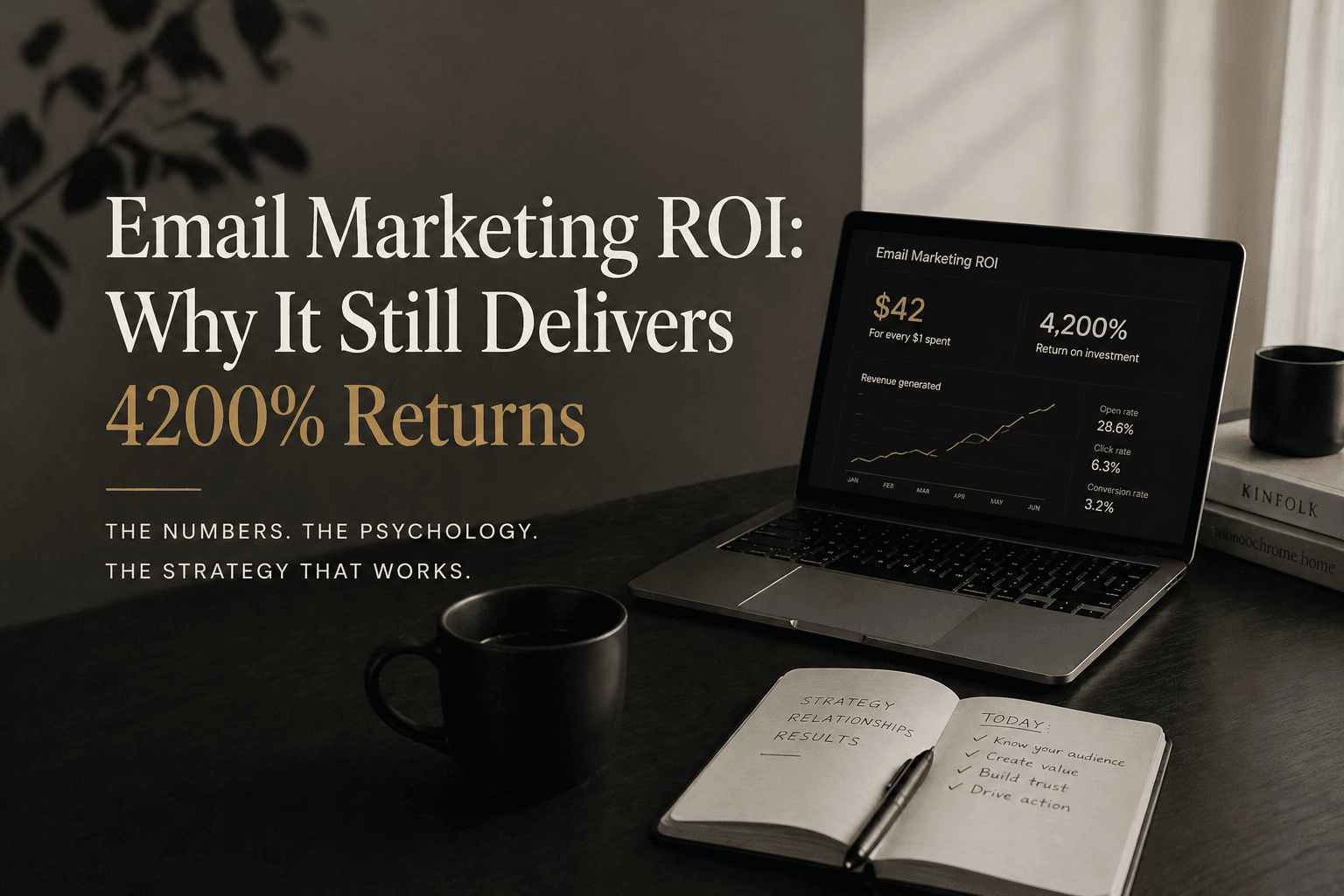
While everyone chases the latest TikTok trend or debates whether AI will replace copywriters, email marketing quietly delivers an average ROI of $42 for every $1 spent. That’s a 4,200% return on investment that makes even the most successful stock picks look modest by comparison.
Yet here’s the paradox: despite these eye-watering numbers, most businesses treat email marketing like that gym membership they pay for but never use. They set up a basic newsletter, blast generic content to everyone, then wonder why their open rates hover around 15% while their unsubscribe rates climb.
The difference between email marketing that pays the bills and email marketing that transforms businesses isn’t just about the size of your list—it’s about understanding the psychology behind why people actually engage with emails in 2024.
The Numbers Don’t Lie (But They Do Surprise)
Let’s start with some context that might shock you. According to recent data from the Data & Marketing Association, email marketing’s ROI hasn’t just remained stable—it’s actually improved over the past three years. While social media platforms fight for attention spans measured in seconds, email enjoys something much more valuable: intentional engagement.
Consider this: when someone gives you their email address, they’re essentially handing you a key to their digital front door. Unlike social media followers who might see 2% of your content thanks to algorithm changes, email subscribers actively chose to let you into their inbox—the most personal digital space most people have.
But here’s where it gets interesting. The businesses seeing those 4,200% returns aren’t just sending more emails—they’re sending smarter ones. They understand that modern email marketing is less about broadcasting and more about building genuine relationships at scale.
Why Most Email Campaigns Feel Like Digital Junk Mail
Walk into any coffee shop and eavesdrop on marketing conversations (don’t actually do this, but you know what I mean). You’ll hear business owners complaining that “email marketing doesn’t work anymore” while simultaneously describing campaigns that sound like they were designed in 2005.
The typical approach goes something like this: collect emails, segment by basic demographics (if at all), write generic subject lines, send the same message to everyone, then wonder why engagement drops faster than a phone with 1% battery.
The problem isn’t the channel—it’s the strategy. Or more accurately, the lack of one.
Modern consumers receive an average of 121 emails per day. Your message isn’t just competing with other businesses; it’s fighting for attention against everything from urgent work communications to that Groupon deal your subscriber forgot they signed up for. In this environment, generic doesn’t just fail—it actively hurts your brand.
The Behavioral Science Behind Email Success
Here’s something most Services providers won’t tell you: successful email marketing is really applied psychology. The campaigns that drive those impressive ROI numbers understand three fundamental human behaviors.
First, people make emotional decisions and then justify them with logic. This means your subject line needs to trigger an emotional response—curiosity, urgency, or genuine value—before your subscriber even opens the email. “Newsletter #47” triggers nothing. “The mistake that’s costing you customers (and how to fix it)” triggers curiosity.
Second, humans are pattern-recognition machines. We notice when something changes or stands out from the norm. If every email in someone’s inbox promises “AMAZING DEALS” and “URGENT SAVINGS,” the one that simply says “A quick question for you” will get opened first.
Third, people crave consistency and reliability in an chaotic digital world. The brands that show up consistently—not constantly, but consistently—build trust over time. This is why successful email campaigns focus on value delivery rather than sales pitches.
Segmentation: The Difference Between Spray and Precision
If you’re sending the same email to your entire list, you’re essentially using a fire hose when you need a laser pointer. Segmentation isn’t just a fancy marketing term—it’s the bridge between generic messaging and genuine connection.
But effective segmentation goes far beyond “customers vs. prospects.” The most successful campaigns segment based on behavior, engagement level, purchase history, and even email client preferences (yes, Gmail users behave differently than Outlook users).
Consider a local restaurant that segments their email list into five groups: first-time visitors, regular lunch customers, dinner-only patrons, special event attendees, and lapsed customers. Each group receives completely different messaging because each group has different needs, preferences, and relationships with the brand.
The first-time visitors get educational emails about menu highlights and restaurant story. Regular lunch customers receive quick updates about daily specials and express ordering options. Dinner patrons hear about wine pairings and special occasion menus. Event attendees get early access to booking private functions. Lapsed customers receive “we miss you” campaigns with special comeback incentives.
Same business, same email platform, five completely different customer experiences. The result? Open rates above 45% and click-through rates that make their competitors jealous.
Timing: When Your Audience Actually Reads Email
Send timing might seem like a minor detail, but it can make or break your campaign’s performance. The difference between reaching someone at the right moment versus the wrong moment can mean 300% higher open rates.
Here’s what the data tells us: Tuesday through Thursday typically perform best for B2B emails, with Tuesday at 10 AM being the golden hour. For consumer brands, weekend mornings often outperform weekday sends because people have more time to engage thoughtfully with non-urgent content.
But—and this is crucial—these are averages, not rules. Your audience might be completely different. The only way to know is to test systematically. A Digital Marketing Agency we work with discovered their audience opened emails at 7 PM on Sundays 40% more than the “optimal” Tuesday morning slot. Why? Their audience consisted mainly of busy professionals who caught up on non-urgent emails during their Sunday evening routine.
Subject Lines That Actually Get Opened
Your subject line has one job: get the email opened. Not to sell, not to explain, not to be clever (usually)—just to create enough interest that someone clicks.
The most effective subject lines in 2024 fall into several categories. Curiosity-driven lines like “The thing nobody tells you about [relevant topic]” consistently outperform promotional language. Personal lines such as “Sarah, quick question about your goals” (when genuinely personalized) create an immediate connection. Benefit-focused lines that clearly state value—”3 ways to cut your software costs by 30%”—work well for B2B audiences.
What doesn’t work anymore? ALL CAPS EVERYTHING, excessive punctuation!!!, obvious clickbait, and anything that sounds like it came from a spam folder circa 2003.
One technique that’s particularly effective is the “cliffhanger” approach. Instead of revealing everything in the subject line, create curiosity that can only be satisfied by opening the email. “The results from our experiment” works better than “Our experiment increased sales by 34%” because the first creates tension that demands resolution.
Content That Converts (Without Being Pushy)
Here’s a counterintuitive truth: the best-performing marketing solutions via email often don’t feel like marketing at all. They feel like valuable advice from a trusted friend who happens to run a business.
The 80/20 rule applies perfectly to email content: 80% value, education, and relationship-building; 20% promotional content. This doesn’t mean burying your offers—it means earning the right to make them by consistently delivering value first.
Successful email content typically follows a simple structure: hook with a relevant story or observation, deliver genuine value (tips, insights, resources), then present a soft call-to-action that feels like a natural next step rather than a sales pitch.
For example, instead of “Buy our productivity software,” try “Since you downloaded our time management guide, you might find our free productivity audit helpful. It takes 5 minutes and shows exactly where your day gets derailed.” Same goal, completely different approach.
Automation: Your 24/7 Relationship Builder
Email automation isn’t about sending more emails—it’s about sending more relevant emails at exactly the right moments. When done correctly, automation feels personal even though it’s systematic.
The most effective automated sequences focus on customer journey stages rather than time intervals. A welcome series might include: email one (immediate welcome and expectation setting), email two (your origin story and why you do what you do), email three (your most popular resource or bestseller), and email four (customer success story that demonstrates value).
Advanced automation includes behavioral triggers: when someone visits your pricing page but doesn’t purchase, when they download a specific resource, when they haven’t engaged in 30 days, or when they make their first purchase. Each trigger starts a tailored sequence designed for that specific behavior.
“The goal isn’t to automate the relationship—it’s to automate the delivery of genuine value at scale.”
Measuring Success Beyond Open Rates
Open rates get all the attention, but they’re often the least important metric for business growth. With Apple’s privacy updates and changing email client behaviors, open rates have become less reliable indicators of success.
Focus instead on metrics that tie directly to business outcomes: click-through rates (are people engaging with your content?), conversion rates (are engaged readers taking desired actions?), list growth rate (are you attracting quality subscribers?), and revenue per email (the ultimate business metric).
One metric that’s particularly revealing is “time spent reading.” Many email platforms now track how long someone keeps your email open. If people are opening your emails but closing them immediately, your content isn’t matching your subject line’s promise.
Integration: Email as Part of Your Marketing Ecosystem
Email marketing doesn’t exist in a vacuum. The most successful campaigns integrate seamlessly with social media marketing, website services, and lead generation efforts.
Your email content can drive social media engagement by including shareable insights. Your website can capture email subscribers through valuable lead magnets. Your branding should remain consistent across all touchpoints, creating a cohesive experience that builds recognition and trust.
Consider how email fits into your broader customer journey. Someone might discover you on social media, visit your website, join your email list, engage with your content, and eventually become a customer. Each touchpoint should feel connected and intentional.
The Future of Email Marketing
As we look toward 2024 and beyond, email marketing is evolving rapidly. Interactive emails, AI-powered personalization, and advanced behavioral triggers are becoming standard rather than cutting-edge.
But here’s what won’t change: the fundamental need for genuine value, authentic relationships, and respect for your subscribers’ time and attention. Technology can enhance these principles, but it can’t replace them.
The businesses that will continue seeing those impressive ROI numbers are those that view email marketing not as a broadcasting tool, but as a relationship-building platform. They understand that behind every email address is a real person with real problems, goals, and preferences.
Getting Started (Or Getting Better)
If you’re ready to transform your email marketing from expense to profit center, start with these immediate actions:
Audit your current approach honestly. Are you sending value or just noise? Are you segmenting based on behavior or just demographics? Are you measuring the right metrics?
Focus on one improvement at a time. Better subject lines, more valuable content, improved segmentation—pick one area and perfect it before moving to the next.
Test systematically. Every audience is different, and what works for others might not work for you. The only way to know is to test, measure, and iterate.
Remember that email marketing is relationship marketing at scale. Every email should strengthen the connection between your brand and your subscribers. When you nail this principle, the ROI follows naturally.
Whether you’re looking for comprehensive business consulting to optimize your entire marketing strategy or specific guidance on email campaign development, the key is starting with a clear understanding of your audience and a commitment to delivering genuine value.
For more insights on building effective marketing systems, explore our Blog for detailed guides and case studies that dive deeper into specific strategies and tactics.